
The Journal
Water housing for beginners: what you actually need to start
By Tommy Pierucki, Waikiki. July 7, 2026.
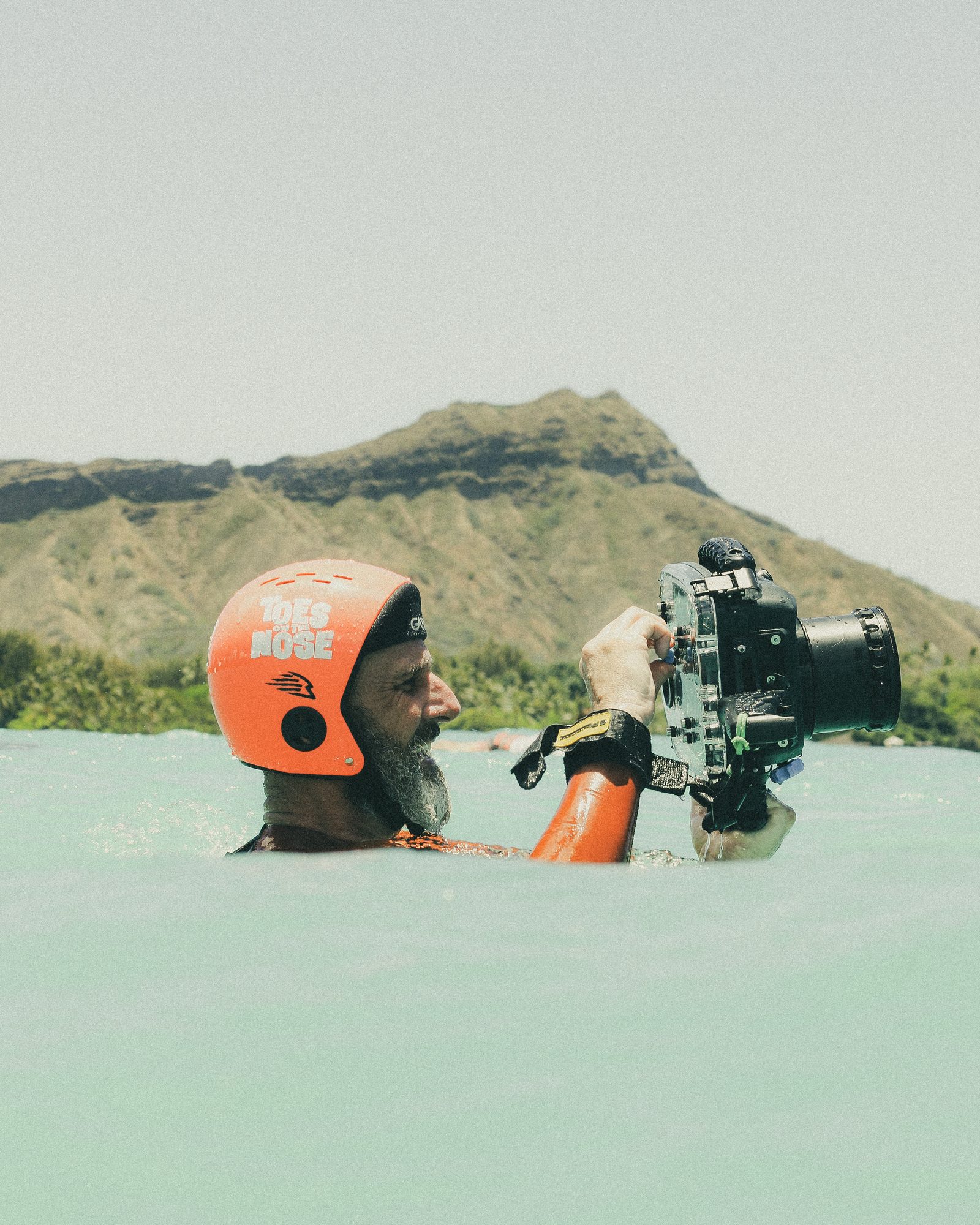
Full disclosure before anything else: I'm an Aquatech affiliate. Aquatech links here use my referral, and code TOMMY5 takes 5 percent off. I was swimming this exact gear years before there was a code, and I don't list anything I don't personally use.
The housing is the most intimidating purchase in water photography. It's expensive, it's mechanical, and it's guarding a camera worth more than the housing itself. So people stall for a year, shooting from the sand, waiting to feel ready.
Here's the truth from someone whose camera lives in one: a housing is a lunchbox with good engineering. Learn a handful of habits and it gets boring, in the best way. What you actually need to start isn't the most serious housing you can stretch to. It's the right rung of a ladder, and the ladder starts cheaper than you think.
Rung one: your phone
The JOBY SeaPal case is what I hand people who want to find out if they even like being in the water with a camera. I love it for a simple reason: when you're out there, everything around you is new and demanding, and the one thing you already know how to use is your phone. No new buttons to learn while a set rolls through.
It's earned a permanent spot in my kit too. I mount it on top of my Aquatech housing a lot, stills with the camera in the housing, video with the phone on top. It's really nice to have video of the same wave you photographed. Honestly, it's just fun.
Rung two: the action camera
A GoPro in its stock case teaches positioning and timing for a few hundred dollars. Its weakness is exactly what teaches you: no reach, no shallow depth, no real shutter control. When you start hitting its ceiling on purpose, you're ready for rung three.
Rung three: the real housing
A machined housing for your actual camera body, with interchangeable ports and control of the camera inside. This is where image quality stops being the limit and you become the limit, which is right where you want to live. My housing is the Aquatech EDGE Pro around a Canon R5 Mark II.
The one rule at this rung: buy the housing for the camera you own, not the camera you're promising yourself. A current housing around your currently owned body beats a dream setup you're still saving for, because the skill only compounds in the water. Every surf photographer started somewhere, and every one of us can tell you the story of our first housing setup.
Ports, the part nobody explains
The housing body is half the system. The port, the glass in front of your lens, is the other half, and it's the part that confuses everyone.
Flat ports are for standard and telephoto lenses. Sharp, simple, predictable. Water droplets on a flat port show up as blur blobs in the frame, so keeping the port clear before every wave matters. I've written up my method for that separately.
Dome ports are for wide angle. The dome corrects how water bends light, keeps your corners usable, and makes split shots possible, half above and half below the surface. Droplets matter less optically on a dome. Scratches matter more.
Adapters and extensions are the rings that make one port fit several lenses at the right spacing, and they're the difference between owning one system and buying new glass for every lens. In my own bag, the workhorse is the 150mm port, because it covers both my 24-105 and my 70-200, and between those two lenses that's most of my sessions.
The mental model: the housing fits your camera, the port fits your lens, the adapter marries the two. Plan the set on paper before you buy anything, and plan it around the lens or two you'll actually use in the water, not the six you own.
Grips and handles
A bare housing with no grips in moving water is surprisingly not easy to use. A pistol grip puts the housing on the end of your arm with a locked wrist, which is how you track a moving surfer while you're moving too, and it's the first accessory I'd buy after the housing itself. A shutter trigger gives you half press focus and full press fire without your eyes leaving the action. A top handle is for the carry and one handed stability in whitewater.
And I always wear a leash on my housing attached to my wrist. Mostly out of habit at this point, but it earns its place: your camera stays near you instead of floating off on its own, where it can ding a board or hurt somebody.
The habits that prevent the flood
Every flooded housing I've ever heard about traces back to a skipped habit, not bad luck. Five habits, every session.
Inspect the O-ring every session: off, wiped with a clean finger, checked for sand and hair, seated properly without twists, because sand you can't see is still sand. And you don't need to grease it on a schedule; grease is for stiff buttons, a little bit maybe every three months.
Close the housing in a dry setting, not near the water. Dry hands, dry housing, good light, because the beach is where seals fail. Double check no cord got pinched, the port is hand tight, and the clamps are shut.
The thirty second check: latches locked, port locked, a test frame, every button pressed once, and a half press to make sure the lens didn't get knocked into manual focus.
The dunk test, every single time. Push the closed housing underwater and hold it for at least five seconds, then tilt it so any water inside collects in the bottom corner away from the buttons. If there's a leak, you find it in the shallows instead of the lineup. I've been doing this for years and I still do it every swim.
Rinse before you open, dry before you open. Fresh water soak after every salt session, work every button while it soaks, towel dry, open indoors.
Do these five things and the scary purchase gets boring. Boring is the goal.
What it costs, honestly
A rough map so nobody gets ambushed: the phone case is genuinely affordable, the action camera path is a few hundred dollars, and a machined housing with one port, a grip, and a trigger lands in the low to mid four figures before the camera inside it. Used housings exist, and they're a fair play, but buy them only with fresh O-rings and a water test, or price in a service.
If that number stings, go back to rung one or two and spend a season there. The ocean will teach you for cheap while you save, and every hour of water sense transfers up the ladder. You'll want fins either way, and I've written up exactly what I wear on my feet and why.
Where to go from here
Two next steps. Everything I actually swim with, piece by piece with current links, lives on the gear page. And the complete version of this article is my guide Water Housings, Demystified: the full ladder, the port system explained properly, every buying decision at every budget, and the maintenance habits that make flooding a story you hear instead of one you tell. The housing you buy first is the most expensive mistake to get wrong, and the guide exists so you don't.